
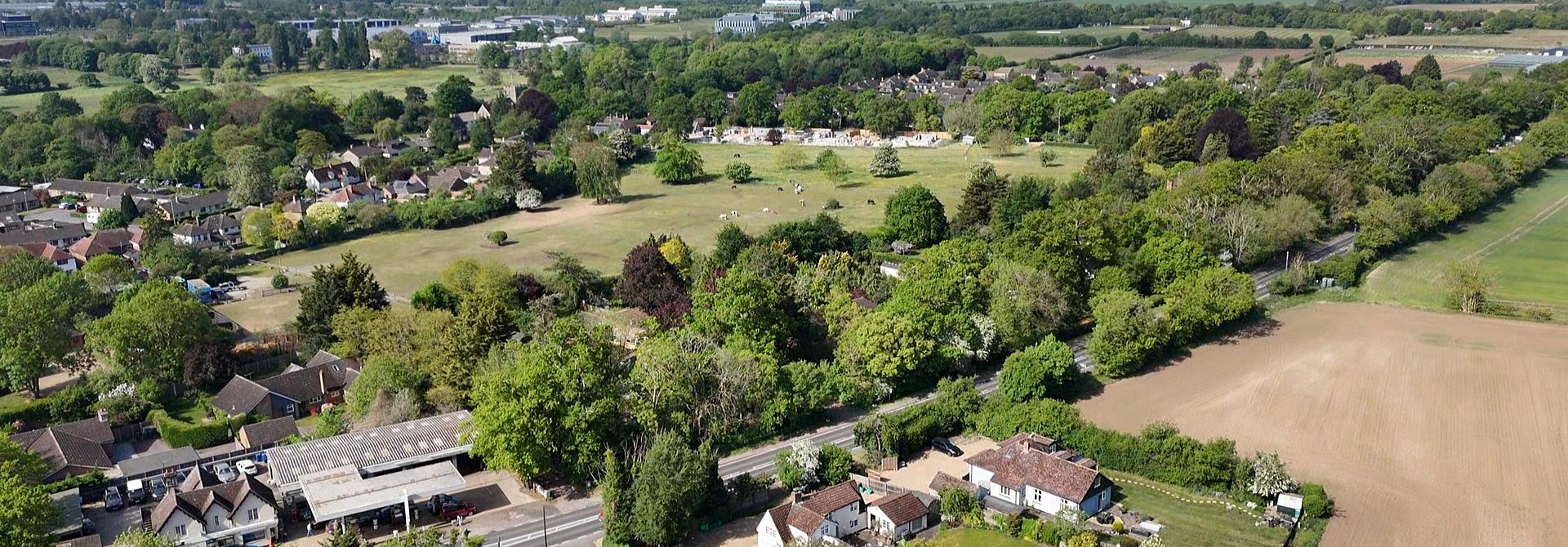
This open agricultural land protects our villages from noise, light, traffic and urban sprawl. A dense new town here would remove that protection entirely — and the chalk landscape simply cannot absorb development on the scale proposed.
Grange Farm is the essential green buffer between the Abingtons and the A11/A1307 corridor. Turning it into a dense new town would erase that buffer and push the villages to the edge of Cambridge.
Grange Farm is open agricultural land that forms the essential green buffer between Little and Great Abington and the A11/A1307 corridor. It shields the villages from noise, light, traffic and urban sprawl.
Turning this landscape into a dense new town would erase that buffer entirely, push the Abingtons to the edge of Cambridge, and sit immediately beside the greenbelt — undermining its purpose and setting a precedent for further expansion.
Grange Farm cannot be judged in isolation. Taken together with the Kingsway Solar Farm and CSET infrastructure, it risks merging into a continuous wall of development along the A11/A1307 — permanently changing the chalk landscape and erasing the green gaps that keep the villages distinct.
A major concern is the uncertainty over the true scale. Policy S/GF mentions 6,000 homes, yet supporting documents refer to 4,750, 6,000 and even 8,000 across nearly 400 hectares. The Council's own HELAA suggests the land can only support 2,883–5,262 homes at rural densities.
This mismatch makes it impossible to judge environmental impacts and raises serious questions about transparency and the evidence base. Whatever the final number, the scale is far beyond what the chalk landscape can absorb.
The buffers shown in the plan are too narrow and too low to screen a large, elevated settlement. They cannot protect long-distance views, prevent light pollution, or maintain the distinct identity of the Abingtons.
Combined with the Kingsway Solar Farm and other major infrastructure, Grange Farm risks creating a continuous urban corridor along the A11/A1307 — replacing open countryside with an unbroken band of development and eroding the separation between villages. Once urbanised, this landscape cannot be restored.
SAVE is not against new homes. We are asking that no decision is taken until the evidence proves this can be done safely. Specifically:
Resolve the 4,750 / 6,000 / 8,000 contradiction so environmental impacts can actually be assessed against a fixed number.
Explain how any figure above the Council's own 2,883–5,262 estimate can be reconciled with rural density and landscape capacity.
Demonstrate how the buffer function between the villages and the A11/A1307 would be maintained — not erased.
Model Grange Farm alongside Kingsway Solar Farm and other corridor projects to test the risk of continuous urban sprawl.