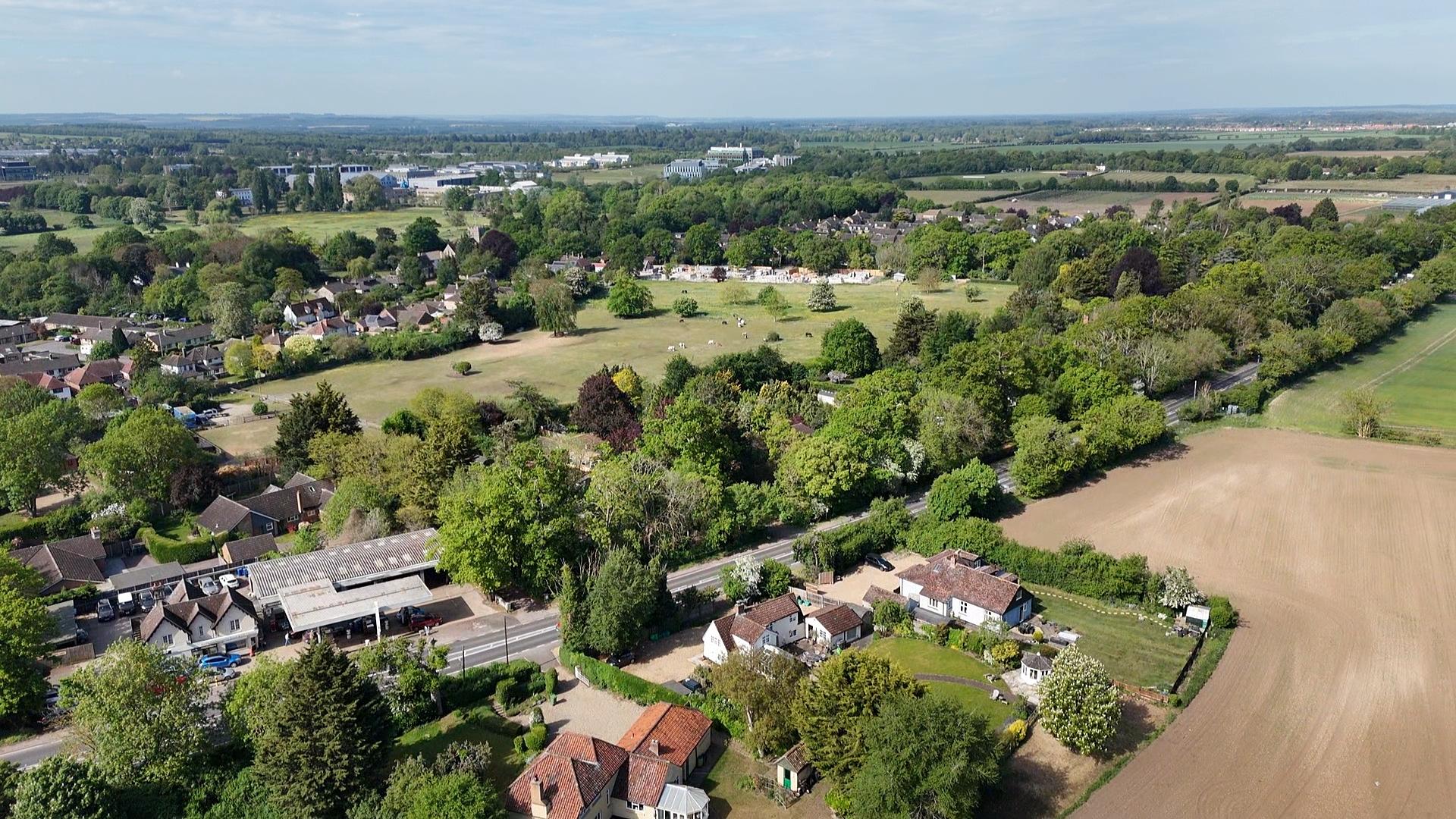
The roads around the Abingtons are already at breaking point. The A1307, A505, A11 and the Fourwentways junction are well-known congestion hotspots — yet the Local Plan proposes a new town of 6,000–8,000 homes without a full Transport Assessment or any proven plan to cope.
Transport is not a detail that can be "fixed later." It is a fundamental constraint — and the evidence shows this location simply cannot support a new town of this scale.
The A1307 corridor and the A11/Fourwentways junction already experience peak-hour congestion, queuing and delays, and the corridor is formally designated a High Casualty Route. It's a sensitive pinch point where even small increases in traffic cause disproportionate impacts.
The Council's own HELAA gives Grange Farm an 'Amber' transport rating — meaning impacts are uncertain and potentially significant — and notes a full Transport Assessment is required for proposals of 50+ dwellings. For a new town of thousands, none has been produced.
Unlike Sawston — which has multiple access points and alternative routes — Grange Farm would funnel almost all traffic through the A1307 and the A11/Fourwentways junction, with no meaningful dispersal options. New developments in Haverhill, Linton and along the corridor feed the same junction. There is simply nowhere for the traffic to go.
Policy S/GF leans heavily on the Cambridge South East Transport (CSET) scheme. But CSET is unfunded, unconfirmed, and its proposed access point would be a 30-minute walk from Great Abington — unrealistic for most residents. There are even suggestions Grange Farm depends on a CSET extension spanning both the A11 and A1307, which is neither costed nor engineered.
Without guaranteed, early-delivered public transport, the development will be overwhelmingly car-dependent. The #13 bus is already overcrowded and unreliable at peak times, with passengers regularly unable to board — and there is no funded plan to expand frequency, capacity or routes for an extra 12,000–20,000 residents.
The Transport Position Paper claims "consistent free-flow traffic" on the A11 and A11/A1307 junction at peak times. That's hard to reconcile with reality: its baseline relies on Google congestion data from 2019–2022 — a period dominated by COVID lockdowns and suppressed travel.
Independent work by the Greater Cambridge Partnership and the A1307 Corridor Project shows the opposite: the corridor is already at capacity and will worsen with planned growth in Linton, Haverhill and along the A11. Even small forecasting errors here could mean severe congestion, worse air quality and real safety risks.
SAVE is not against new homes. We are asking that no decision is taken until the evidence proves this can be done safely. Specifically:
Modelled on real post-pandemic traffic — not suppressed 2019–2022 lockdown data — before any allocation is confirmed.
Clear answers on construction and occupation routes, and how the A11 slips and Fourwentways junction would cope without gridlock.
Secured funding and enforceable phasing so buses and CSET are operational before homes are occupied — not years later.
Proof that walking, cycling and bus use can realistically replace car journeys in a rural location, with expanded #13 capacity and routes.
Traffic from Grange Farm assessed together with Haverhill, Linton and other growth that loads the same junction.