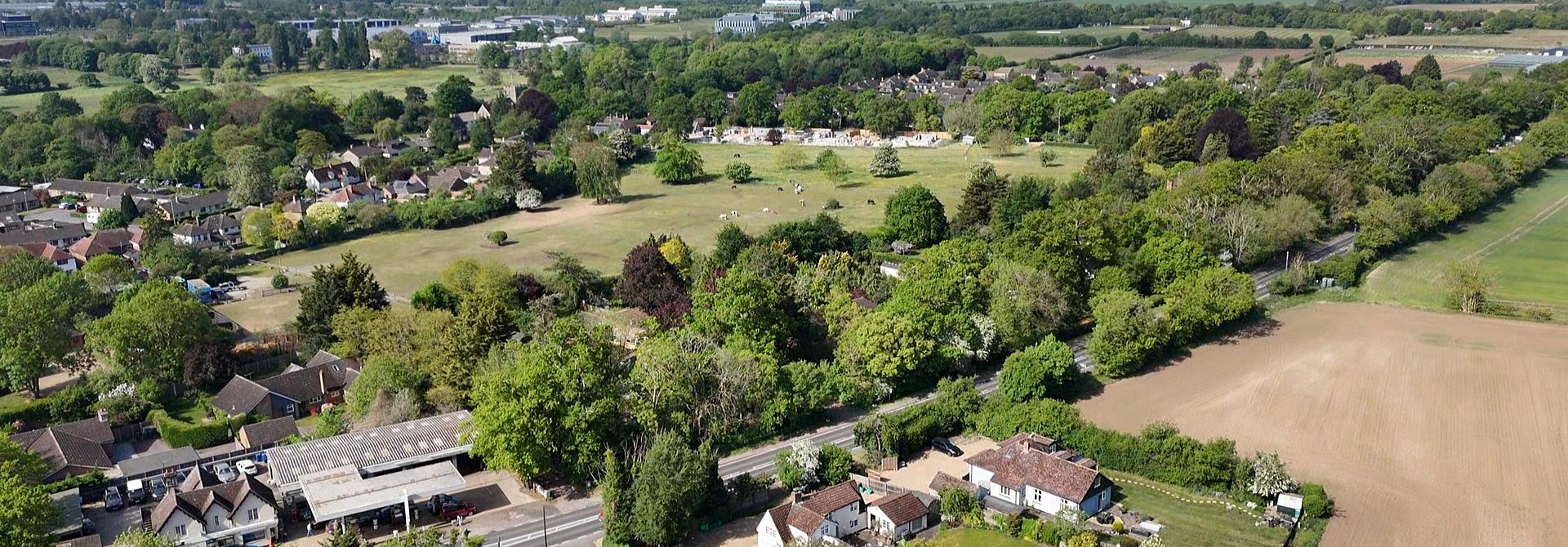
The Abingtons sit above one of the most fragile, over-stressed chalk aquifers in the UK — the same aquifer that supplies 99% of Cambridge's drinking water and feeds the River Granta, one of the world's rarest chalk streams. That system is already in crisis. Building a new town on top of it could break it for good.
Despite a chalk aquifer already in crisis, the Grange Farm proposal would place a new town directly on top of the catchment that keeps it — and the River Granta — alive.
The River Granta has dried up in recent years — completely in 2019, and close again in 2023. Aquifer recharge now fails in around 40% of winters, and the Environment Agency has formally designated the region as "seriously water stressed."
This isn't a distant risk. The chalk aquifer and the River Granta are irreplaceable: once damaged, they cannot be restored. Protecting them matters not only for the Abingtons, but for the entire Cambridge region.
At Northstowe — a similarly sized development — construction works severed local groundwater pathways, causing ponds in nearby Longstanton to dry up. Despite clear evidence, the impact was dismissed as "not significant" and excluded from the Environmental Impact Assessment. The same mistake cannot be repeated in a chalk catchment that is even more vulnerable.
The Grange Farm proposal would add 6,000+ homes, 15,000m² of offices, 20,000m² of warehousing, roads and facilities directly on top of the chalk recharge zone. Large-scale development on chalkland disrupts natural infiltration, increases surface runoff, and accelerates aquifer depletion.
When impermeable surfaces — roads, roofs, pavements — replace fields, less water reaches the groundwater, and the chalk streams that depend on it simply run dry. Water flowing off a hilltop development would also increase erosion and flood risk in Little and Great Abington, while starving the aquifer of the slow-release recharge the Granta needs to keep flowing.
The Council's own evidence (HELAA) gives the site an 'Amber' flood-risk rating, acknowledging surface-water and groundwater impacts as a major constraint. Yet the Local Plan provides no hydrological modelling, no groundwater monitoring data, and no demonstration that the aquifer can sustain the development.
The Environment Agency has repeatedly stated that development must not cause deterioration of waterbodies, and the Government's own joint statement on water scarcity in Greater Cambridge confirms that current plans cannot protect chalk streams without new strategic water sources — which won't be operational until the mid-2030s.
SAVE is not against new homes. We are asking that no decision is taken until the evidence proves this can be done safely. Specifically:
A site-specific assessment of how dewatering and deep foundations would affect the chalk aquifer and the flow of the River Granta — before any allocation.
Continuous level and quality monitoring across the site and neighbouring watercourses, to create a legal baseline that can't later be blamed on "dry weather."
How oil, tyre rubber and brake dust from the new town will be treated before reaching the ground or river — the Granta already holds only 'Moderate' ecological status.
No allocation before the strategic infrastructure (e.g. the Fens Reservoir) is secured — current NPPF rules require sites to be genuinely deliverable.
Policy S/GF must contain comprehensive, enforceable safeguards for the chalk aquifer — not the single aspirational line it currently includes.